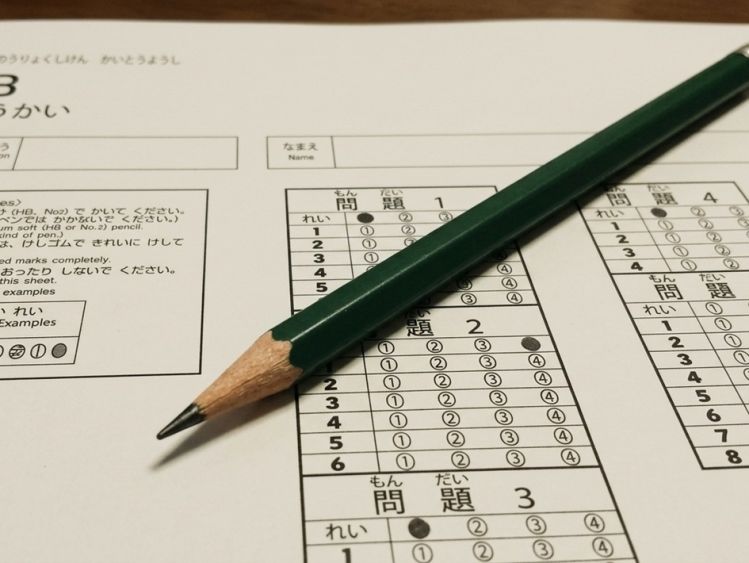
The JLPT (Japanese-Language Proficiency Test) is the most widely taken Japanese exam in the world. It has five levels, from N5 (beginner) to N1 (advanced), and every level includes a listening section.
With the JLPT just around the corner, you’ve probably been working on your listening. But there’s one small skill that is easy to overlook: taking notes while you listen.
In the JLPT listening section, the conversation keeps moving and you don’t have time to stop and think. When a conversation includes several numbers, times, or steps, trying to hold all of it in your head is a recipe for mistakes.
The good news is that you’re allowed to write in your question booklet during the listening section. So let’s make the most of it.
Notes are not useful for every question. They matter most when the conversation includes information that is easy to mix up, such as:
In these questions, the speakers often mention several options, change their minds, or correct themselves. The final answer is not always the first thing you hear.
You don’t need a complicated system. Here are three rules that will get you started.
1. Write
as little as possible.
Your notes are not a transcript. Use digits for numbers, and write only the key
words. Don’t write full sentences. If you are still finishing a word when the
next sentence begins, you are writing too much.
2. Use
whatever is fastest for you.
You don’t have to write in kanji, or even in Japanese. Hiragana, English, or
your own abbreviations are all fine. Arrows (→) are handy for showing order,
and a cross (×) is useful for something that was rejected or corrected.
3. Keep
listening, even if you miss something.
If you lose a detail, let it go. Stopping to catch up means you’ll miss the
next part too. It’s better to have one gap in your notes than to lose track of
the whole conversation.
Here’s the catch. Note-taking is a skill, not just a piece of knowledge. If you try it for the first time on test day, you’ll probably find yourself so busy writing that you miss the key point. On the other hand, if you’ve practised enough, writing becomes automatic and you can focus on understanding.
The tricky part is that it’s hard to tell by yourself whether your notes are actually working. Did you write too much? Did you miss the information that mattered? Did you note down something that turned out to be irrelevant? These are things that are much easier to see with a second pair of ears.
Note-taking habits are very personal. What works for one learner may not work for another, so it helps to practise with someone who can give you feedback.
At SuikaTalk, our JLPT tutors can work through listening questions with you. After each question, you can explain in your own words what you chose to note down and why, and your tutor can tell you what was useful, what was unnecessary, and what you might have missed. They can also show you how they would approach the same question. Along the way, you’ll start to notice your own patterns, such as which type of information you tend to lose.
Even a single lesson focused on this one skill can make a real difference, and it fits easily into a busy schedule before test day.
If you’d like to feel more confident in the listening section, why not give it a try?
👉 Find your JLPT tutor on SuikaTalk