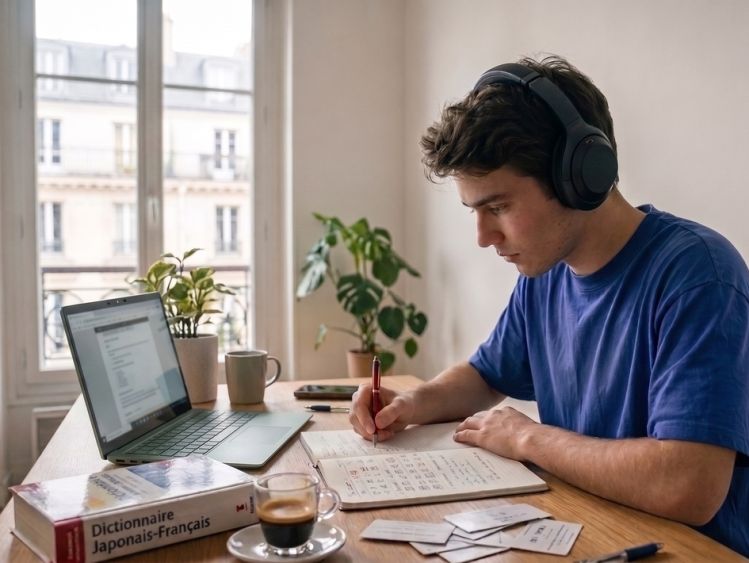
If you’re starting to learn Japanese, there’s a good chance you’ve already tried an AI voice. Maybe it’s a translation app that reads phrases aloud, or a chatbot that can speak. They’re convenient, easy to access, and available at any hour.
To be clear, this isn’t an article telling you to avoid AI. I think it’s a genuinely useful tool. But there’s one thing about AI voices that’s easy to miss when you’re learning, and it’s worth knowing about.
AI is great for quick translations, for explaining a word or a grammar point in English, for creating practice sentences, and for answering your questions whenever you’re studying, even late at night. And the voices have become remarkably natural. Used this way, AI can be a real help in your study routine.
There is a catch, though. As a native Japanese speaker, I notice that AI voices in Japanese are very good at reading words correctly, but they can still sound slightly "off”, particularly over longer passages. In a short phrase, the small oddities are barely noticeable. Over several sentences, they add up, and a voice that sounded perfectly natural for a few seconds can start to feel a little strange after half a minute. This is true as of October 2026, but the technology moves fast, so it may change.
What makes this tricky is that it’s usually hard to say exactly what’s wrong. Unless you have a background in phonetics or linguistics, you often can’t point to the specific mistake. It’s more a feeling that the voice doesn’t quite sound like a person talking.
It might seem odd to say that you can hear a problem without being able to explain it, but every native speaker does this with their own language. Take English as an example. English has a surprisingly regular set of patterns for where the stress falls in a word. As a general rule, words ending in -tion, -ic or -ity are stressed on the syllable just before the ending: atTENtion, hisTORic, aBILity. Words ending in -ate or -ous are usually stressed two syllables back: CELebrate, DANgerous. And words ending in -ee, -eer or -ese carry the stress on the ending itself: emploYEE, engiNEER, JapaNESE.
Did you know these patterns before you read this? Learners of English are often taught them, but native speakers usually aren’t, so some of them may be seeing them for the first time right now. Yet native speakers follow these patterns without thinking. If a voice said ATtention instead of atTENtion, or ENgineer instead of engiNEER, it would sound wrong straight away. You’d know something was off, even if you had no idea there was a rule behind it. And if English isn’t your first language, the same is true of yours: there are almost certainly sounds in it that would strike you as wrong the moment you heard them.
That’s what is happening when native Japanese speakers listen to an AI voice. A lifetime of listening has taught native speakers what natural Japanese sounds like, so even a small deviation stands out, whether or not they could tell you which rule was broken.
Often the deviations have to do with pitch, meaning how high or low the voice is from moment to moment. Japanese uses pitch in a different way from English stress. In Japanese, the pitch pattern of a word can change its meaning. For instance, はし means "chopsticks” or "bridge” depending on its pitch pattern. And beyond single words, there is the flow of a whole sentence: how the pitch rises and falls, where the voice pauses, and which parts get a little more emphasis. If these are slightly off again and again, the result can sound unnatural to a native Japanese listener, even when every word is technically correct.
Now think about this from a learner’s point of view. A native speaker can hear these differences because of a lifetime of listening. A learner hasn’t had that yet. Your ear has been trained to pick up what matters in your first language. Some of what matters in Japanese is different, so building a new ear takes a long time and a lot of listening. In my experience, even learners who have studied for years can miss these differences.
That means that if the voice you’re copying is slightly off, you probably won’t notice, and you’ll learn the "off” version. Japanese speakers will usually still understand you, but your Japanese may sound less natural than you’d like. And it’s much harder to fix a habit later than to learn it correctly from the start.
Keep using AI for the things it does well. But to build your ear for how Japanese actually sounds, make sure you also listen to plenty of real Japanese, spoken by real people.
Because it’s so hard to hear what you’re missing, though, listening alone isn’t always enough. That’s where a teacher comes in. A teacher listens to you, not just to a recording. They notice when a sound or its pitch isn’t quite right, they correct it on the spot, and they explain why, which is exactly what you can’t yet do for yourself. AI and a teacher work well together: AI for quick answers and practice, and a teacher for the part you can’t hear yet.
Many teachers on SuikaTalk offer a free trial lesson, so why not start there? Find a teacher on SuikaTalk and hear the real thing for yourself. Not sure what to expect? Read You Don’t Need to Prepare Anything for Your Trial Lesson.